
AI Can Generate Intelligence.
It Cannot Make Systems Work.
As AI scales into multi-agent and autonomous environments, the constraint is no longer capability, it is whether systems produce coherent, reliable outcomes.
Golden Goose
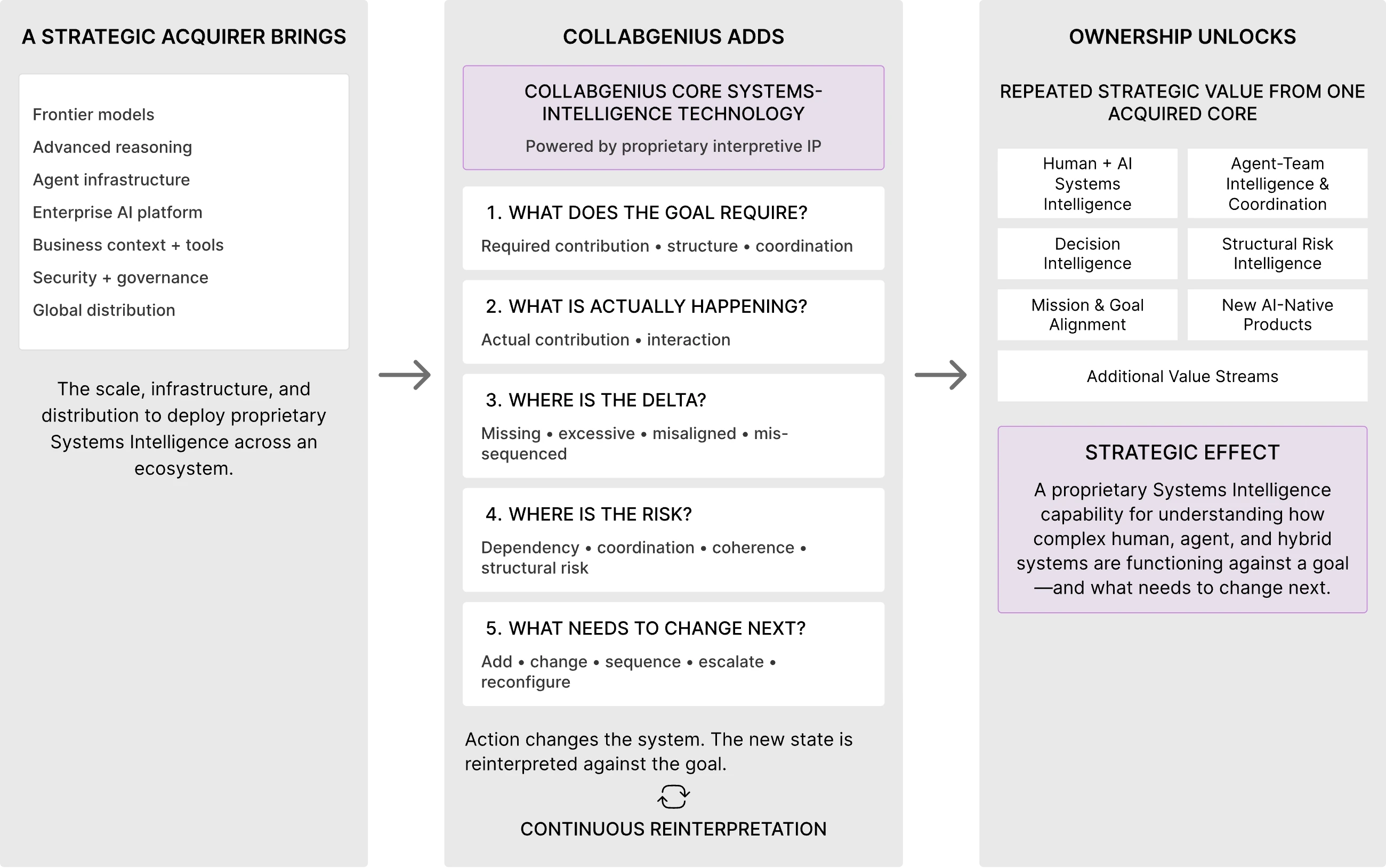
CollabGenius gives a strategic acquirer ownership of proprietary Systems Intelligence that can be deployed across models, agents, enterprise systems, and human+AI systems.
The Problem
Current AI architectures operate at the level of:
• tokens
• prompts
• responses
• task execution
They do not operate at the level of:
• contribution
• interaction
• system dynamics
As a result:
• multi-agent systems drift
• outputs conflict or duplicate
• execution becomes inconsistent
• intelligence fails to translate into reliable outcomes
Without system-level interpretation, AI produces activity, not aligned execution.
The Missing Layer
CollabGenius introduces a systems interpretation layer.
It interprets how entities contribute, predicts how those contributions interact, and structures systems to produce coherent outcomes.
This enables:
• real-time interpretation of contribution across agents
• prediction of interaction outcomes across systems
• structural alignment without prescribing behavior
This is not orchestration.
It is the layer that determines whether systems function coherently.
Why It Cannot Be Replicated
CollabGenius is not derived from training data or conventional AI development.
It is built from:
• decades of encoded behavioral systems logic
• direct observation of interaction across real environments
• a structured ontology of contribution not present in AI architectures
Its logic:
• is not visible in outputs
• is not contained in datasets
• is not inferable through model behavior
Replication would require reconstructing the system from first principles and validating it across real-world environments over time.
This is not an improvement to AI systems.
It is a capability current AI systems do not have.
What Is Being Acquired
CollabGenius is a complete systems interpretation architecture.
It governs how intelligent systems:
• interpret contribution
• coordinate across entities
• produce outcomes under real conditions
This is not a model, product, or framework.
It is a standalone capability layer: the ability to determine whether intelligence produces outcomes at scale.
Strategic Impact
Ownership establishes a structural advantage across AI systems:
Agent System Reliability
Prevent breakdowns in multi-agent workflows and align distributed intelligence
Enterprise AI Deployment
Enable AI to function within real organizational systems—not just data environments
Next-Generation AI Products
Move from assistive AI to systems that coordinate and execute across entities
As AI capability scales, generation commoditizes. The constraint becomes system-level coherence.
CollabGenius defines this layer.
It determines whether intelligent systems produce outcomes or fail under complexity.
Ownership determines which platforms can make AI systems work and which cannot.

.svg) 500-1900 Glades Road,
500-1900 Glades Road,
Boca Raton,
Florida 33431.svg) marci@collabgenius.ai
marci@collabgenius.ai.svg) 754.707.2155
754.707.2155