

The Limits of Probabilistic Scaling: Compute Margins, Multi-Agent Drift, and the Governance Deficit
The enterprise artificial intelligence sector has arrived at a structural impasse. For the past three years, the dominant hypothesis governing enterprise technology roadmaps has been direct and singular: scale resolves all systemic failure modes. The assumption held that as frontier foundation models expanded their context windows, parameter volumes, and multi-step reasoning capabilities, the operational hazards of enterprise AI—hallucination, coordination collapse, latency, and drift—would attenuate asymptotically toward zero.
Public market filings, macroeconomic operating realities, and large-scale multi-agent deployments have dismantled this premise.
When foundational models operate within isolated single-turn prompts or conversational interfaces, statistical probability produces persuasive approximations of reasoning. However, when enterprise architectures attempt to chain autonomous agents together to execute multi-node, end-to-end business workflows, the underlying mathematical architecture of probabilistic next-token prediction ceases to be an asset. It becomes an unconstrained liability.
The challenges confronting enterprise platforms are neither engineering bottlenecks nor temporary optimization hurdles. They represent fundamental boundaries inherent to probabilistic architectures: the compute margin crisis, systemic multi-agent drift, and an insurmountable governance deficit.
1. The Compute Margin Crisis: The Exhaustion of Recursive Reasoning
The first failure mode is fundamentally economic. In enterprise environments, autonomous agents do not fail in silence; they fail through recursive consumption.
When an autonomous agent network attempts to reach consensus across complex business workflows—reconciling divergent goals across operational, legal, financial, and strategic nodes—it does so through natural language dialogue. Because probabilistic models lack an external, objective coordinate plane to verify state boundaries, they negotiate alignment via continuous re-prompting, multi-turn conversational verification loops, and iterative self-critique.
In production, this architecture triggers severe compute bloat:
- Token Amplification: A single operational decision that should require sub-millisecond execution instead consumes thousands of recursive reasoning tokens.
- Margin Compression: Recent financial disclosures across leading frontier AI research laboratories demonstrate that compute consumption routinely absorbs roughly 50% of top-line revenue ($5.6 billion in compute spend against $11.6 billion in quarterly revenue), resulting in negative or heavily compressed GAAP operating profiles.
- Delivery Margin Erosion: For global systems integrators and enterprise software platforms deploying agentic frameworks, the operational burden is severe. Enterprise deployments frequently absorb 15% to 30% margin erosion purely in engineering hours spent remediating non-deterministic workflow breakdowns, deadlocks, and runaway loop cycles.
Attempting to govern multi-agent coordination by asking probabilistic models to "reason harder" about their own coordination generates an exponential cost curve. The economic model of enterprise software has always relied on the near-zero marginal cost of computation at scale. Multi-agent token recursion inverts this dynamic: scaling coordination increases compute intensity exponentially while diminishing reliability.
2. Multi-Agent Drift: The Mathematics of Compounding Uncertainty
The second failure mode is architectural. In any complex dynamic system, cascading statistical processes compound error exponentially rather than linearly.
Consider an enterprise workflow governed by a chain of five autonomous agents: an intake agent, an analysis agent, a compliance evaluation agent, a strategic orchestration agent, and an execution agent. If each individual agent operates with an ostensibly high statistical accuracy of 95%, the cumulative deterministic reliability across that five-node chain collapses immediately:
P(Systemic Success) = 0.955 ≈ 77.4%
In an enterprise environment handling mission-critical operations, a 22.6% systemic failure rate is catastrophic.
Because LLMs reason strictly from internal probabilistic weights, each agent possesses an inherent tolerance for drift. When autonomous agents exchange context through unstructured natural language, slight interpretive ambiguities in Node 1 compound into divergent assumptions in Node 3, culminating in complete execution deadlocks or rogue state transitions in Node 5.
Frontier labs have attempted to resolve this through heuristic guardrails, system prompts, and external "watchdog" models. Yet these solutions remain fundamentally probabilistic: they attempt to govern a statistical model with another statistical model.
Language is an expressive medium for communication, but it is an inherently unstable substrate for system control. Operating systems do not manage CPU memory allocation using conversational English; relational databases do not manage ACID transactions via statistical prompts. The execution boundary of an autonomous enterprise requires mathematical invariance, not semantic debate.
3. The Enterprise Governance Deficit: The Rise of Uninsurable Liability
The third failure mode is legal and regulatory. As autonomous agents move from passive advisory interfaces into active execution environments—modifying corporate ledgers, allocating clinical resources, issuing automated underwriting decisions, or altering infrastructure configurations—liability becomes sovereign.
The corporate consequence of probabilistic drift is the emergence of a structural insurability ceiling:
- The Invalidation of Traditional Underwriting: When an AI model’s internal decision topology is a non-transparent, trillion-parameter black box, risk cannot be mathematically bounded. Formal risk disclosures in public market filings now explicitly warn of a catastrophic inflection point: autonomous AI actions may cause disproportionate, systemic harm exceeding the aggregate underwriting capacity of the entire global commercial insurance market.
- Statutory Compliance Mandates: Regulatory frameworks—including the EU AI Act (Title III High-Risk Systems), US EEOC governance mandates, and statutory bias prohibitions—explicitly demand reproducible audit trails, transparent state transitions, and absolute non-discrimination.
- The Failure of Demographic Proxies: Current enterprise attempts to eliminate algorithmic bias rely heavily on superficial post-hoc filtering: masking demographic fields, appending heuristic constraints, or retraining model outputs. These interventions consistently fail under formal legal diligence because statistical embeddings continually infer demographic proxies from secondary operational signals.
If an enterprise cannot prove precisely why an autonomous agent executed a specific state transition, how that decision was bounded, and that the operational logic is mathematically free from demographic proxies, the system remains uninsurable and commercially non-viable for core enterprise workloads.
4. The Architectural Requirement: A Decoupled Deterministic Control Plane
The resolution to the limits of probabilistic scaling does not lie in building larger foundational models. It requires a fundamental paradigm shift: the formal architectural separation of the cognitive layer from the coordination control plane.
Foundation models excel at cognitive tasks: unstructured data extraction, semantic synthesis, localized code generation, and multi-modal perception. They are phenomenal engines of interpretation. They must not, however, function as the state engine of systemic coordination.
To achieve sustainable economics and institutional safety, enterprise architecture requires an external, deterministic coordination layer operating on continuous non-linear coordinate geometry:
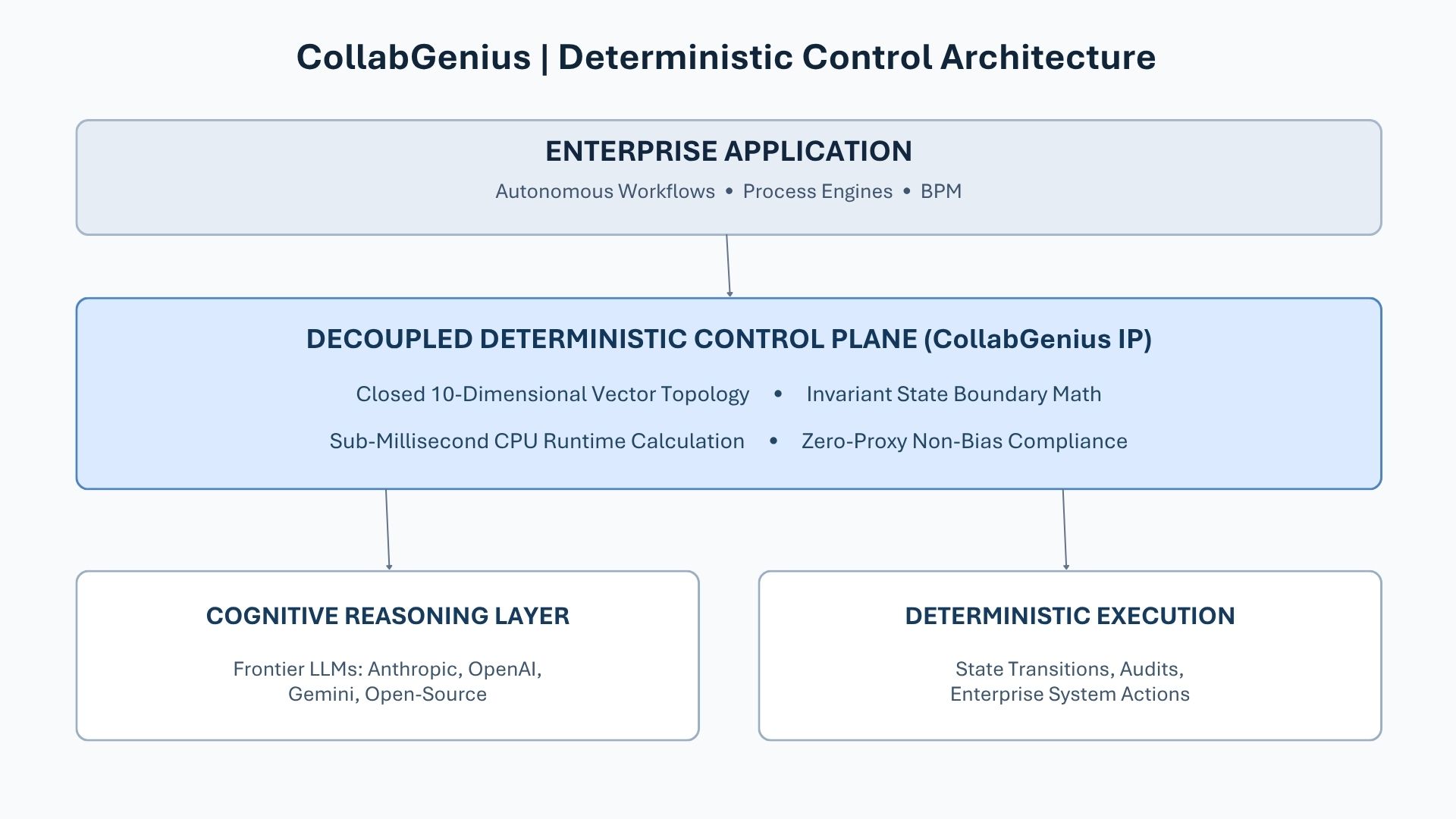
- Sub-Millisecond CPU Geometry vs. Multi-Token Prompting: Instead of forcing autonomous agents to negotiate balance, alignment, and priority through multi-turn conversational tokens, systemic equilibrium is calculated instantaneously on a CPU runtime as an invariant geometric state vector. Coordination strain is detected and resolved in sub-millisecond execution before an agent executes a workflow.
- Structural Contribution vs. Demographic Proxies: By evaluating operational states across a closed, 10-dimensional matrix of universal operational functions rather than semantic text profiles, the coordination layer operates completely independent of identity labels or socioeconomic proxies. Non-bias and statutory compliance (EEOC, ADA, EU AI Act) cease to be speculative targets requiring fine-tuning; they become the direct mathematical consequence of measuring functional contribution geometry.
- Deterministic Auditability (f(x) → y): Every state transition, routing choice, and equilibrium boundary is governed by closed-form mathematical equations. The decision log is mathematically invariant, fully reproducible, and provable in court or before an insurance underwriting committee.
The Window of Strategic Consolidation
The enterprise AI infrastructure landscape is entering a defining period of structural consolidation. As foundation model capabilities commoditize across frontier labs, the basis of competitive differentiation is shifting rapidly from raw model intelligence to runtime reliability, compute margin sustainability, and deterministic governance.
Platforms and systems integrators that continue to rely solely on probabilistic middleware will find themselves constrained by compounding compute costs, delivery margin erosion, and uninsurable operational drift.
The enterprises that dominate the next decade of autonomous business execution will not be those that simply deploy larger models. They will be the platforms that integrate an invariant, deterministic control plane—securing the mathematical foundation required to convert probabilistic intelligence into scalable, defensible, and sovereign enterprise value.

