

The Compounding Fallacy of Multi-Agent Systems: Why Statistical Accuracy Guarantees Systemic Failure
Across enterprise software engineering, the dominant paradigm for scaling artificial intelligence has shifted from monolithic prompts to multi-agent orchestration. The operational premise appears intuitive: decompose complex business logic into discrete autonomous agents—intake, semantic reasoning, policy validation, orchestration, and execution—and allow each node to execute its specialized sub-task.
However, enterprise deployments are encountering a severe mathematical barrier. Despite individual agents exhibiting benchmarked accuracy rates between 90% and 95%, entire multi-agent pipelines frequently break down in production. Workflows freeze in recursive retry loops, outputs diverge from regulatory boundaries, and human engineering teams are forced into manual remediation.
This is not an implementation bug, nor is it a temporary limitation of model reasoning. It is the direct consequence of the Compounding Fallacy: the erroneous assumption that probabilistic independence can sustain deterministic enterprise reliability at scale.
1. The Multiplicative Collapse of Chained Probabilities
In traditional deterministic software engineering, services interact via strongly typed contracts, structured APIs, and invariant state machines. If Service A passes data to Service B, the data structures and transition rules are mathematically bounded.
In multi-agent generative architectures, agents interact through natural language context and probabilistic next-token predictions. Because each agent reasons statistically rather than deterministically, every autonomous node introduces a non-zero margin of variance.
When these probabilistic agents are chained sequentially, their individual reliability does not average out; it compounds multiplicatively:
P(Systemic Success) = p₁ × p₂ × p₃ × ... × pₙ
Or expressed in formal product notation:
P(Systemic Success) = ∏ pᵢ
Where n represents the number of sequential autonomous agent nodes and pᵢ represents the deterministic reliability of each individual node.
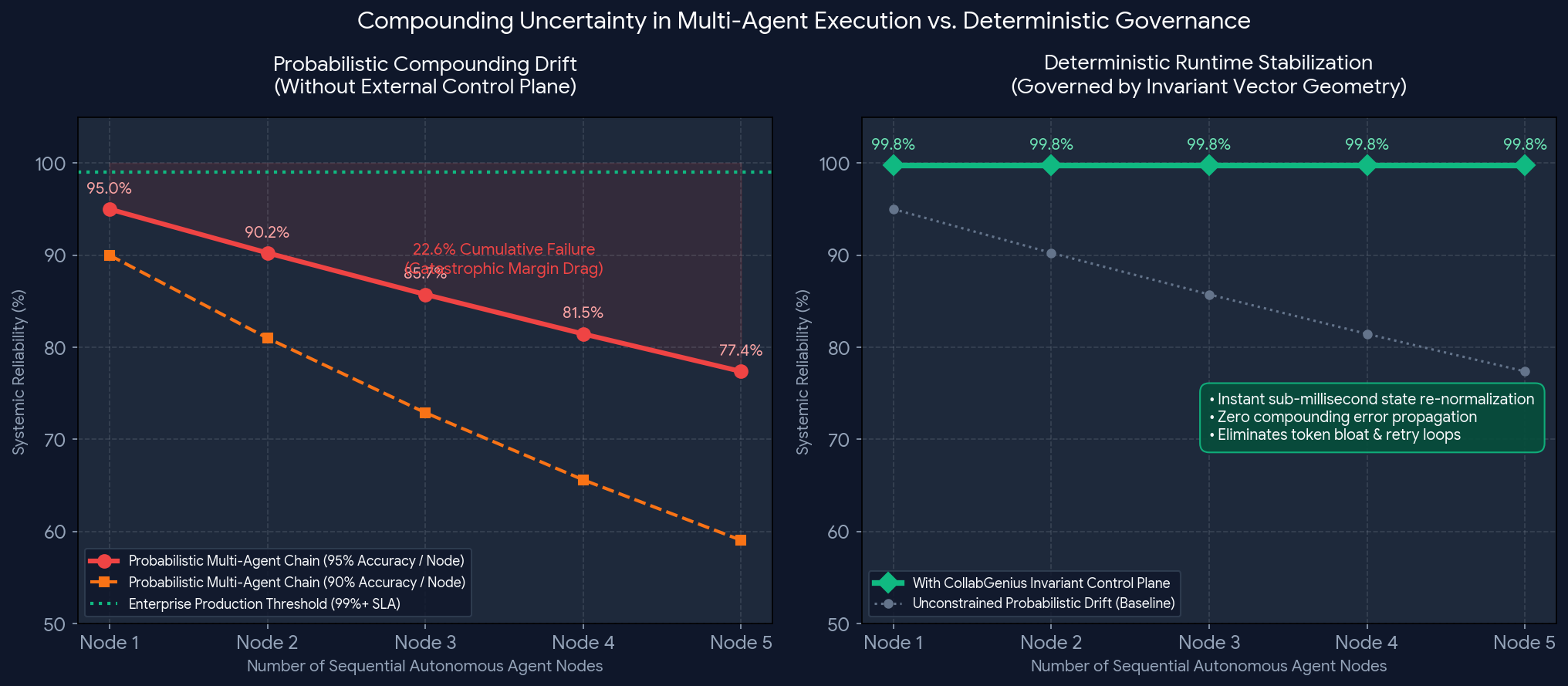
Consider an enterprise workflow governed by a chain of five autonomous agents operating with an ostensibly high individual accuracy of 95%:
P(Systemic Success) = (0.95)⁵ ≈ 77.4%
Across just five operational hand-offs, systemic reliability deteriorates to 77.4%, generating an immediate 22.6% cumulative failure rate.
If individual agent accuracy drops slightly to a standard commercial benchmark of 90%, the degradation accelerates exponentially:
P(Systemic Success) = (0.90)⁵ ≈ 59.0%
In an enterprise environment processing thousands of daily transactions, financial audits, or patient intake records, a systemic failure rate between 22.6% and 41.0% represents an uninsurable operational catastrophe.
2. Visualizing Compounding Drift vs. Deterministic Governance
The divergence between statistical agent chaining and invariant systems governance is structural:
3. The Margin Crisis: Why "Reasoning Harder" Inverts Software Economics
When probabilistic multi-agent chains begin to drift, how does contemporary AI infrastructure attempt to correct the error?
Because existing frameworks lack an external coordinate plane of ground truth, they rely on semantic self-correction:
Agent 2 notices ambiguity in Agent 1’s response and issues a clarifying prompt.
Agent 3 evaluates Agent 2’s critique and runs an iterative verification loop.
A "critic" or "supervisor" agent is layered on top to arbitrate disagreements between conversational outputs.
This approach attempts to solve a statistical failure mode by layering more statistical models on top of it. The operational consequence is immediate delivery margin erosion:
Token bloat: Multi-turn conversational arbitration turns a millisecond execution requirement into multi-thousand-token recursive loops.
Latency degradation: Transactions that should complete instantaneously stall in multi-second verification hand-offs.
Margin compression: Systems integrators and SaaS platforms absorb 15% to 30% margin hits purely to cover the cloud compute and engineering remediation costs required to keep unstable workflows from breaking.
Software economics have historically scaled on near-zero marginal cost per transaction. Probabilistic multi-agent recursion inverts this economic law: scaling agent coordination exponentially increases compute expenditure while systematically reducing outcome predictability.
4. The Solution: Decoupling Cognitive Synthesis from Coordinate Governance
Frontier foundation models are exceptional engines of cognitive synthesis: extracting context from unstructured documents, parsing nuanced language, and translating human intent into code.
However, foundation models cannot govern systemic state transitions because they do not possess a mathematical representation of system equilibrium. They generate candidate outputs based on statistical likelihood; they do not enforce dynamic balance across interdependent nodes.
To achieve production-grade stability, enterprise architecture requires the formal separation of the cognitive model from the coordination control plane:
Cognitive Layer (LLMs / SLMs): Ingests domain data, performs localized task synthesis, and proposes operational actions.
Deterministic Control Plane (CollabGenius Systems Intelligence): Intercepts proposed actions across an invariant, closed-form coordinate geometry.
Rather than allowing agents to pass unconstrained natural language assumptions down the chain, the control plane calculates whether the proposed state transition maintains systemic coherence. If coordination drift or role vacancy is detected, the engine normalizes the state in sub-millisecond CPU runtime before the next node executes.
5. From Probabilistic Chaining to Sovereign Enterprise Control
Enterprise platforms cannot achieve category dominance or institutional trust on a 77.4% reliability foundation.
As frontier models commoditize, competitive advantage will not belong to the platforms that deploy the most complex multi-agent prompts. It will belong to the enterprise platforms that anchor autonomous agent execution to an invariant, deterministic control plane—securing the mathematical certainty required to scale mission-critical systems without compounding failure.

